Content Strategy · Privacy UX · Terminology · Meta
Designing for trust at scale
Conversations with businesses on Messenger and Instagram looked just like conversations with friends, even though the rules governing the two were very different. I led the terminology and disclosure work that helped users tell them apart, at a scale of more than 100 million people a day.
When you opened Messenger or Instagram, a conversation with a business looked exactly like a conversation with a friend. The chat bubbles, the notifications, the interface, all of it was indistinguishable. The privacy rules governing those conversations, however, were not the same.
Business chats aren't private in the way personal chats are. Businesses can see the conversation, and the data inside it is handled accordingly. At the time, nothing in the product told users any of that.
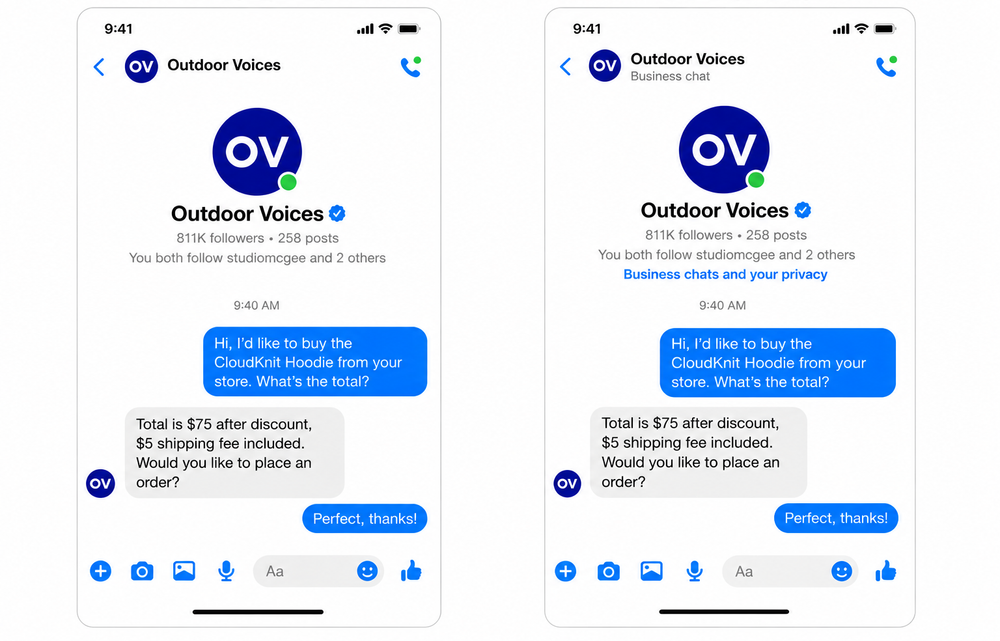
It was a trust risk and a legal risk operating at massive scale, in plain sight. Solving it meant satisfying compliance, supporting Meta's advertising business and writing something that would actually make sense to the person holding the phone.
Visibility vs. interface simplicity.
Business growth vs. user trust.
Globally scalable from day one.
Before anything else, there was a naming problem. These conversations needed a label users could recognize at a glance — something that told them, without explanation, that the rules here are different.
The alternatives the team had considered were anchored on account type or tooling: language that would have made complete sense inside Meta and zero sense to a user scrolling their inbox. None of them carried the meaning forward into the moment when a user actually needed to understand it.
The label has to be the explanation.
I led the terminology strategy, evaluated alternative names and drove cross-functional alignment on Business chats. It was plain language, globally translatable and descriptive rather than branded. It was extensible enough to grow across surfaces without breaking. And, importantly, it gave users a clear mental model for what was happening before they ever had to think about it.

Naming the category was the first move. The second was deciding how to surface the disclosure: when, where and in what language.
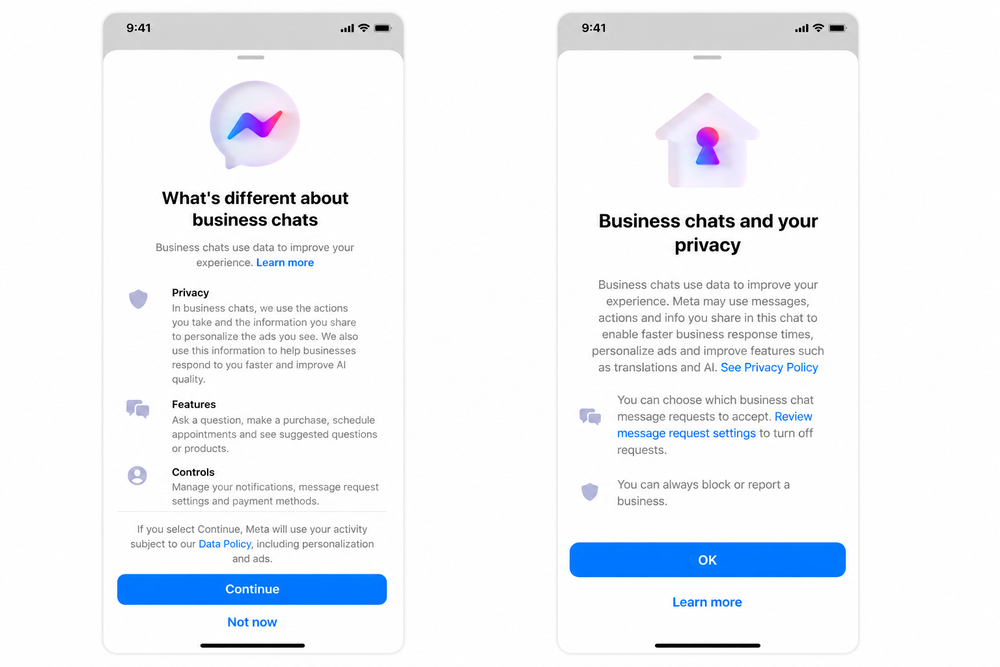
The existing pattern wasn't working. A long legal footer ran below the chat, leaving the critical privacy information below the fold and unlikely to be seen by the people who needed it.
I moved the privacy information forward, embedding a policy link directly in the body copy and rewriting the disclaimer in conversational terms, all while preserving visual simplicity and legal accuracy. The goal wasn't to hide the complexity but to deliver it at the right moment, in language people could actually parse.
A project like this only ships when legal, policy, product, design and engineering all line up — which doesn't happen unless someone is doing the translation work between them.
Each team came in with its own non-negotiables: legal needed the language to be accurate and defensible; policy needed the experience to keep user trust intact; product needed it not to hurt adoption; design needed the visual system to hold; and engineering needed something they could actually ship.
Content design was the connective tissue. My job was to hold all of those constraints at the same time and find language that satisfied them at once, or to make the trade-off visible when they were genuinely irreconcilable, so the team could make the call.
The shipped experience introduced Business chats as the terminology standard across Messenger and Instagram. The label surfaced in the chat header, where every user opening a conversation with a business would see it without having to go looking.
The consent flow surfaced at the right moment in the user journey, in language designed to feel like an explanation rather than a legal notice. I also authored the supporting Help Center article, where users who wanted more detail could find it in plain language.
The system was designed to be extensible, so the terminology and disclosure patterns could hold as new business messaging products were introduced, without requiring a redesign every time.
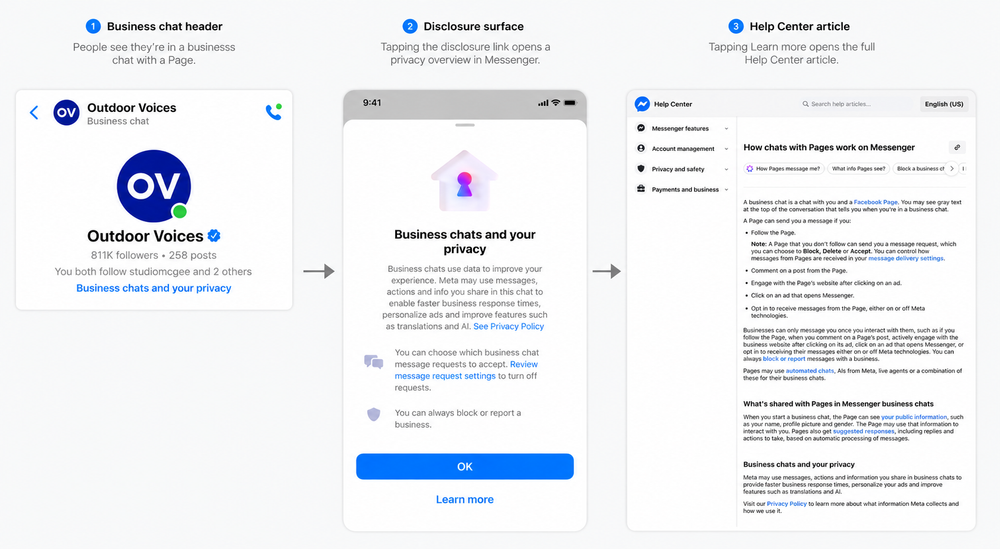
This work directly enabled Meta to leverage chats for business purposes, with clear differentiation between conversation types, improved privacy visibility and a scalable foundation that supported responsible growth. The broader compliance project surfaced a consent experience to hundreds of millions of daily active users, exceeded its advertising-eligible outcome goals by 400%+ and unlocked significant incremental revenue. "Business chats" became the terminology standard across Messenger and Instagram, and a pattern other teams continued to build on.