Staff Content Designer
I started as a journalist. I still think like one.
Point of viewThe right words don't just explain the product. They shape what people notice, trust and do next.
Year-over-year sales growth supported through Meta.com Store content strategy.
Prescription attach-rate growth after launching and iterating Meta's first regulated health care purchase flow.
Pages coordinated for Meta Connect — the company's biggest hardware launch of the year.
Users reached by the privacy and disclosure systems I designed for business messaging at scale.
Featured work
Selected cases.
Eight cases across AI systems, commerce, trust and high-scrutiny user experiences.
Configuration is not checkout
Two failed experiments. One diagnosis. The highest-impact feature the team shipped in Q1 2026 — and a case study in what happens when you treat browsing like a transaction.
Read case study →
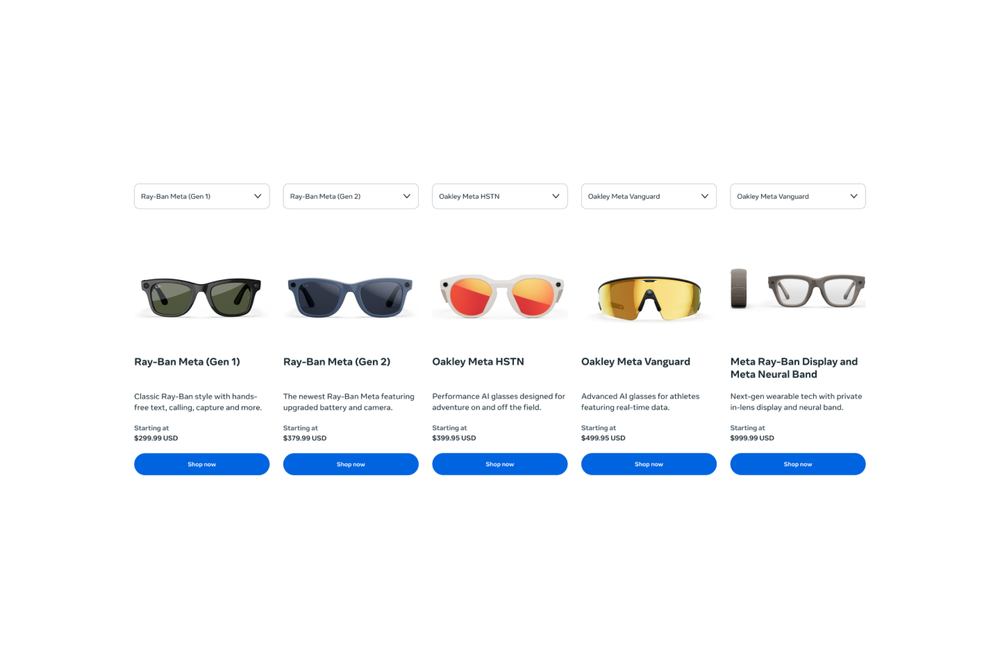
Helping people compare AI glasses
Meta's AI glasses portfolio was growing fast. Users needed a clearer way to understand what changed across products — and which model made sense for them.
Read case study →

Designing for trust at scale
Business chats looked identical to personal ones. Same interface, completely different privacy rules. I named the difference, moved the disclosure and built a pattern that held at hundreds of millions of users.
Read case study →
A regulated product in a store built for everyone else
Meta's first regulated product had to live across every surface where users discover, decide and buy, without taking over a store mostly built for shoppers who don't need a prescription. Rx attach climbed from 2% to 14% in one quarter, 40% above goal.
Read case study →
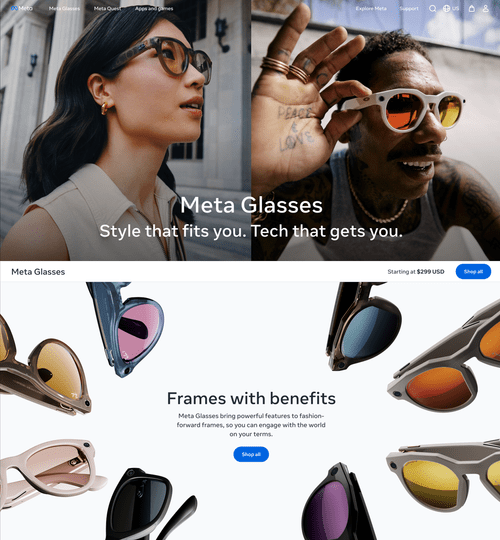
Frames with benefits
A 2025 content strategy for the Meta Glasses landing page that didn't ship. A year later, the live page converged on it — and the headline I wrote landed verbatim in a Meta marketing email to millions.
Read case study →
Thinking & artifacts
How product language decisions get made.
The systems, frameworks and decision-making behind the work.
Wearables funnel — content strategy reference
Content principles and decision logic across CLP, overview, Shop All, PDP, quick buy and cart. Includes experiment results and content opportunities.
Available on request
Simplified Rx flow — content strategy reference
Copy rationale and content principles for the prescription purchase journey, from customization through review and upgrades.
Available on request
AI glasses — terminology governance
User-facing names, category language, lens labels and CTA rules across the wearables portfolio. What's user-facing vs. internal, and why.
Available on request
Content experiment results — wearables funnel
Documented experiment results across CLP, overview, Shop All and post-ATB surfaces. Lift data, key learnings and implications for content strategy.
Available on request
Principles
How I think about language in product systems.
Find the real question.
Good content begins with understanding what people need to know, not what teams want to say.
Design for understanding.
The goal isn't simplicity. The goal is helping people make informed decisions.
Trust is part of the product.
Privacy disclosures, regulated experiences and AI systems succeed or fail on trust.
Content is a system.
Guidelines, governance and tooling matter as much as the words on the screen.
Reduce uncertainty.
Every interaction should leave people more confident than they were before.
Clarity drives outcomes.
Better understanding leads to better outcomes for users and businesses alike.
I learned content design in newsrooms before anyone called it content design.
I started as a copy editor, where every day was a puzzle: words, space, hierarchy, deadlines and judgment. I've been solving variations of that same puzzle ever since — just at a much different scale.
At Meta, I spent my first two years on business messaging, shaping the privacy and disclosure systems that told users what was actually happening to their data. The next two I moved to the Meta.com Store, where I led content across wearables and prescription eyewear during a period of rapid portfolio growth.
I use AI daily for research, prototyping and the kind of competitive synthesis that used to take a week. AI makes me faster. It doesn't make the decisions. More recently, I've been building knowledge bases and Claude skills that help cross-functional teams produce better content by embedding content standards directly into their workflows.
Outside of work: puzzles (the kind that take over your dining room table), VR boxing and Gutsy Broads — a community I founded that now has 48K members on Facebook.
Experience
Content lead for Meta.com — AI glasses, VR headsets and prescription eyewear — during rapid portfolio growth. Contributed to 6.5x year-over-year sales growth. Owned nearly all content for Meta Connect end-to-end across 20+ pages and 12+ net-new surfaces. Drove an AI-first initiative building knowledge bases, agents and Claude skills for cross-functional teams.
Led content strategy for privacy and disclosure systems across Messenger and Instagram. Introduced "Business chats" as the terminology standard for business messaging. Designed consent and disclosure experiences surfaced to hundreds of millions of daily active users.
Led content strategy and client relationships for Facebook, GE, Johnson Controls and Mastercard. Built and ran the agency's copy desk and video unit. Managed staff writers and freelancers globally.
Wrote and optimized copy for a global cybersecurity company. Improved UX, quality scores and conversion rates. Designed and executed A/B tests.
Led production on Forbes.com (40M+ monthly users), using analytics and A/B testing to improve performance.
Developed social and SEO strategy, introduced A/B testing tools, trained staff and improved audience growth. Previously copy editor, 2001–2007.
Managed and edited technology team, using SEO and performance data to guide assignments and optimize content.
Skills & tools
UX Writing
Microcopy, error states, onboarding flows, empty states, tooltips, CTAs, product naming and in-product notifications.
Content Strategy
Content architecture, terminology governance, style guide development, editorial frameworks and cross-functional consulting.
Experimentation
A/B testing strategy and execution via Optimizely and Google Analytics. Data-informed copy iteration and conversion optimization.
Design Collaboration
Embedded in product and design workflows using Figma. Comfortable in lo-fi wireframes and hi-fidelity prototypes.
AI Practice
Daily use for deep research, content prototyping and prompt engineering. Building knowledge bases, agents and Claude skills for cross-functional teams. Comfortable editing HTML and CSS.
Leadership
Mentored content and product designers. Managed editorial teams and freelancers across complex multi-brand programs.
What colleagues say
Calm in complexity. Sharp on craft.
"Samantha excels at leading complex projects from chaos to clarity. She manages multiple projects and priorities all while making it look easy."
"Sam is a fantastic writer among writers. In terms of craft, she is on a different level. She uses this to inspire her fellow CDs to embrace their writerly instincts."
"Projects like these can often become a pendulum as the design shifts between extremes. By contrast, Samantha effectively fielded input and requirements, incorporating everyone's priorities without discarding existing considerations."
"Sam has significantly contributed to my team's success by being extremely communicative and understanding of the needs and timelines of web development."